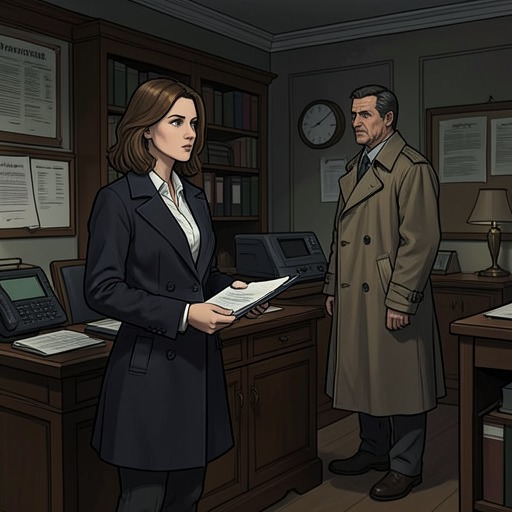
Åsmund Bjørnstad
The SonÅsmund Bjørnstad is a detective inspector with Kripos whose authority brings him into conflict with Simon Kefas during a murder investigation. At first he presents the institutional certainty of a takeover and dismisses Simon’s interpretation of the crime; later, when the investigation reaches Nestor and the wider criminal network, he sets that rivalry aside and asks Simon for help. His changing stance makes him a measure of how the evidence alters the case’s apparent scale.
Identity and Introduction
Bjørnstad first appears at a crime scene where Simon and Kari Adel have arrived to investigate a body. Simon encounters him crouched beside the body and a medical examiner; the detective inspector introduces himself as a member of Kripos and tells Simon that the service is taking over. He says Simon’s own superior authorized the arrangement, placing the decision above the two investigators’ immediate disagreement.
The takeover reflects Kripos’s stated practice: when asked to assist with a murder inquiry, it requires overall responsibility for both the tactical and technical investigation. Simon knows this arrangement has previously set Oslo Police’s Homicide Squad and Kripos at odds. He also recognizes that accepting the handover would leave him free to return to the Vollan investigation, but he elects to remain involved and look around the scene.
Conflict with Simon’s Interpretation
Bjørnstad initially treats the case as an ordinary murder rather than an assassination. When Simon calls it an assassination, Bjørnstad scoffs that Simon is trying to impress his young student, Kari, and tells her that the older detective’s account is making real life sound more exciting than it is. He insists on his own assessment and tells Simon to leave after a brief, pointed allowance of respect for his seniority.
The dispute is more than a clash of temperaments: Simon believes the circumstances point to a targeted killing, while Bjørnstad’s initial framing reduces it to a conventional homicide. Later discussion shows that Bjørnstad also considers a gang-related explanation, interpreting the use of a large quantity of Superboy as a message to competitors. Simon challenges that reasoning, arguing that gangs would not need to spend so much to send a message. The disagreement captures the investigation’s recurring effort to distinguish a plausible surface explanation from the underlying pattern.
Continued Presence at the Investigation
Bjørnstad remains involved as the inquiry develops. At a later scene, he appears in the doorway with two people carrying a stretcher and says that the body is to be moved. Simon and Kari have already examined what they need, and Simon asks whether they may look around. The moment shows the practical limits of the two teams’ uneasy cooperation: Kripos controls the scene, but Simon continues to pursue his own lines of inquiry.
The case eventually supplies evidence that bears directly on Simon’s reading of it. When a body is found in a cage, Bjørnstad has lost the arrogance he displayed at the earlier scene. He is pale, has called Simon directly, and tells him that Kripos needs help. The remains are provisionally identified as Hugo Nestor’s through credit cards, pending confirmation by dental records. Police officers who removed the Argentine mastiffs explain that the dogs had not been fed; the discovery makes the killing’s circumstances central to the investigation rather than incidental background.
Nestor, the Criminal Network, and the Search
Bjørnstad understands the importance of the discovery: Nestor was Kalle Farrisen’s boss, and Bjørnstad anticipates the public and institutional consequences once the press learns of Nestor’s death. His earlier confidence has given way to a practical recognition that the investigation needs assistance. Simon asks how police found Fidel Lae, and Bjørnstad explains that patrol cars at the farm had followed a phone signal.
Simon then proposes a public appeal: the police should issue a description and wanted notice and send a photograph to NRK and TV2. Bjørnstad doubts that anyone will recognize the person from the image, but Simon presses for a quick broadcast. The exchange shows Bjørnstad participating in the operational response even as Simon argues for a broader and more urgent search.
The case’s wider context makes the earlier disagreement consequential. Simon’s account of the old police-mole rumors describes a suspected leak to the person controlling much of Oslo’s drug and sex-trafficking activity, whom police called the Twin. Evidence of cooperation between Iversen Property and the Twin later brings the investigation beyond an isolated murder or a simple gang message. Bjørnstad’s changing position—from asserting Kripos’s control and dismissing Simon’s theory to requesting his assistance—tracks the widening recognition that the cases and criminal relationships are connected.